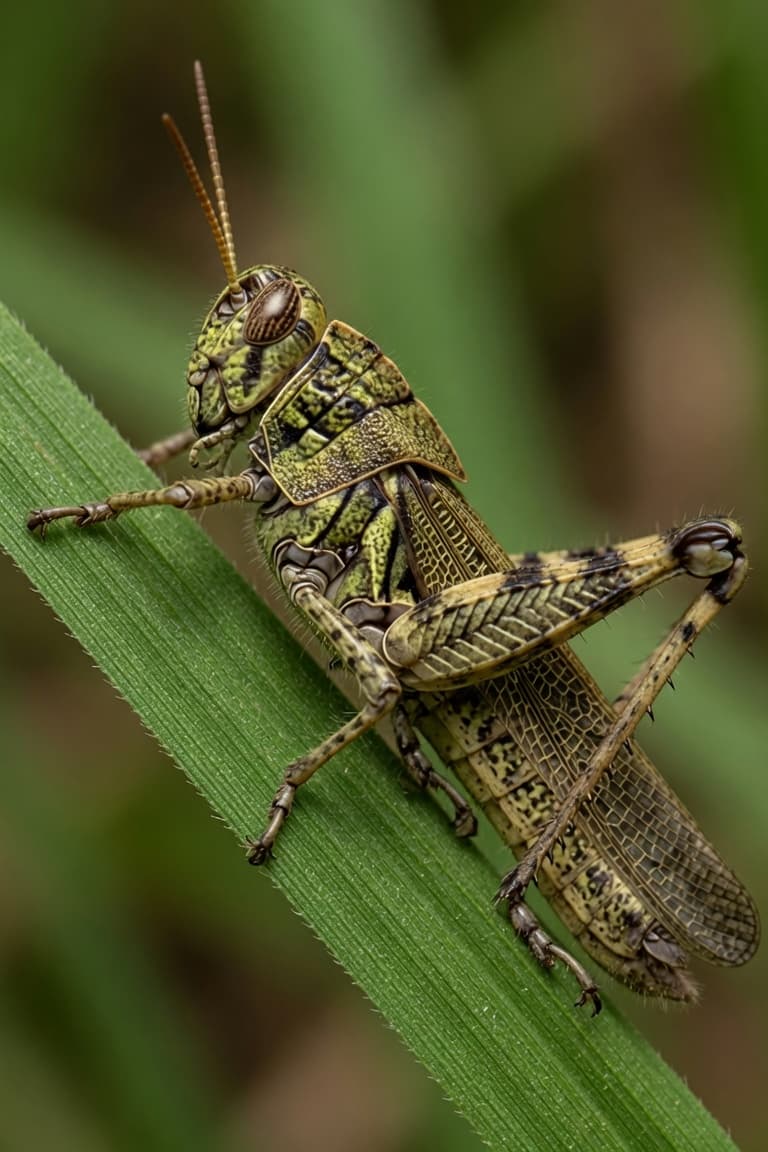
Walk the fence line on the south side of a dry pasture this week and you'll see them — pinhead-sized hoppers boiling up out of the grass with every step. They're not in the corn yet. They're sitting in the ditch, the grassy terrace, the un-tilled headland where last fall's adults laid their egg pods. That's exactly where you want to deal with them, and exactly the kind of strip a ground rig hates to treat.
A handful of growers and a couple of ranchers asked us about grasshoppers in the last two weeks, all with some version of the same question: do I spray the whole field, or is there a smarter way? For most of you, this week, the answer is the border — and that's a job a drone is genuinely built for. Here's the honest version, thresholds and dollars included.
Why the Border Is the Whole Game Right Now
Grasshoppers don't hatch evenly across a field. They hatch in concentrated egg beds — fencerows, roadside ditches, grassy waterways, the untilled margins around crop ground — and the nymphs stay bunched up in those hatching areas for a while before they fan out into the crop. Oklahoma State's December 2025 grasshopper management guide puts it plainly: most field-crop damage shows up in the first 50 to 100 feet of the border as hoppers move in from the ditch. Hit them while they're still concentrated and still immature, and you protect the whole field by treating a fraction of it.
Timing is the other half. Nymphs are far easier to kill than adults. UNL Extension's guidance for scouting field borders is blunt that control measures against adults are "less effective," with "tremendous variability" once they're fully grown. OSU pins the window down to mid-May through about July 1, while they're immature. That's now. By the time the hoppers are big enough to clatter off your windshield on the gravel road, you've largely missed the cheap, effective shot.
So the decision in front of you this week isn't really "spray or don't." It's "treat the borders now while it's a nymph problem, or fight adults across the whole field in August."
Do You Actually Have a Problem? The Threshold
Before anybody flies anything, scout. The square-foot method UNL recommends is low-tech and works: pick a spot a few feet ahead, walk toward it counting the hoppers that jump out of an imaginary one-square-foot box, repeat 18 times, and divide the total by two. That gives you grasshoppers per square yard.
Then check it against the treatment guidelines UNL publishes, which OSU reprints and credits to Nebraska:
- In the field: 0–2 per square yard is non-economic. 8–14 means treatment is probably warranted. 15 or more, treat.
- In the borders: 11–20 is questionable. 20–40, probably. 41 or more, yes.
On rangeland the bar OSU uses is that control "is probably never justified until numbers exceed 12 per square yard," and even then it depends on forage value and treatment cost. The point of the numbers is the same on every acre: don't spray a field that doesn't need it, and don't ignore a border that's loaded.
Why This Is Drone Work
Here's where the machine matters. A 150-foot border treatment is the textbook move — UNL notes a border spray "may be effective with as little as 150 feet," though a heavy source area can call for a quarter to a half mile. Picture a quarter-section field. Treating a 150-foot strip all the way around it works out to about 34 acres instead of the full 160 — you're spraying barely a fifth of the ground to protect all of it.
A ground rig can do a border, but it's clumsy at it — driving the perimeter, fighting the ditch bank, skipping the wet corner, compacting the headland you're trying to protect. An airplane doesn't want a 36-acre wrapping strip either. A drone flies the exact ribbon you draw, follows the fence line and the irregular ditch, gets into the pivot corner and the soft spot a sprayer would rut up, and treats the un-tilled refuge grass that isn't crop ground at all. Border spraying, ditches, terraces, odd corners, small pastures — that's the lane where the drone quietly wins, and at our insect abatement rate of $13 per acre with a $400 trip minimum, treating 34 acres of border pencils out a lot friendlier than broadcasting 160.
The RAAT Angle on Pasture and Rangeland
If the problem is in a grass pasture or on rangeland rather than a crop border, there's a second reason the drone fits: Reduced Agent and Area Treatment, or RAAT. Instead of blanketing the ground, you spray alternating treated and untreated swaths and let the hoppers' own movement carry them onto treated forage.
The economics are real. University of Wyoming's RAAT program data shows 80–95% control — only about 5–15% below a full blanket spray — while cutting costs roughly 50–60% and putting 60–75% less insecticide on the land. OSU reports the same range: RAAT "will probably reduce application costs by 50–60%," uses 65–70% less product, and still delivers up to 85% control. The catch worth knowing: diflubenzuron (Dimilin) is currently the only insecticide that specifically allows a RAAT application, and because it's an insect growth regulator that kills through molting, it only works on immature nymphs. Another reason the calendar matters.
A drone is, in effect, a precision RAAT platform. It can lay 100-foot treated swaths against 100-foot skips on command and hold that pattern on terrain an aerial applicator would charge a premium for. This is the kind of work that ties straight back to pasture and rangeland management — protecting forage you're counting on for grazing.
Where the Drone Loses — and It Does
We'd rather tell you the limits up front. If you've got a square, contiguous section of rangeland that genuinely needs a full broadcast — high densities, tall forage, no time — an airplane will cover that ground faster and cheaper per acre than a drone working tank by tank. The drone's edge is borders, refuges, awkward shapes, and RAAT strips, not 640 acres of open blanket spray.
Second, the window is unforgiving. If you wait until the hoppers are adults, the Dimilin RAAT play is off the table entirely, contact products give variable results no matter what's holding the nozzle, and you're spending real money for a partial kill. The drone doesn't fix late timing.
Third, scout honestly. UNL's 2025 risk note is a good reminder that grasshopper pressure tracks hot, dry conditions — and that spotty high densities show up even in low-risk years. A bad-looking fencerow doesn't always mean a field-wide problem. Count first. If you're under threshold, keep your $400 in your pocket and we'll tell you so.
The Bottom Line
Grasshoppers are a border problem before they're a field problem, and a nymph problem before they're an adult problem. The cheap, effective shot is a targeted border or RAAT treatment in the next few weeks, while they're still small and still bunched in the ditch — and that targeted, irregular, get-into-the-corner work is exactly what a drone does better than the alternatives.
If you're seeing hoppers stacking up in your borders or pasture and want a straight read on whether you're over threshold and whether the drone's the right tool, call (402) 326-5811 or reach us through the insect abatement page. We'll help you scout it before anything leaves the tank.