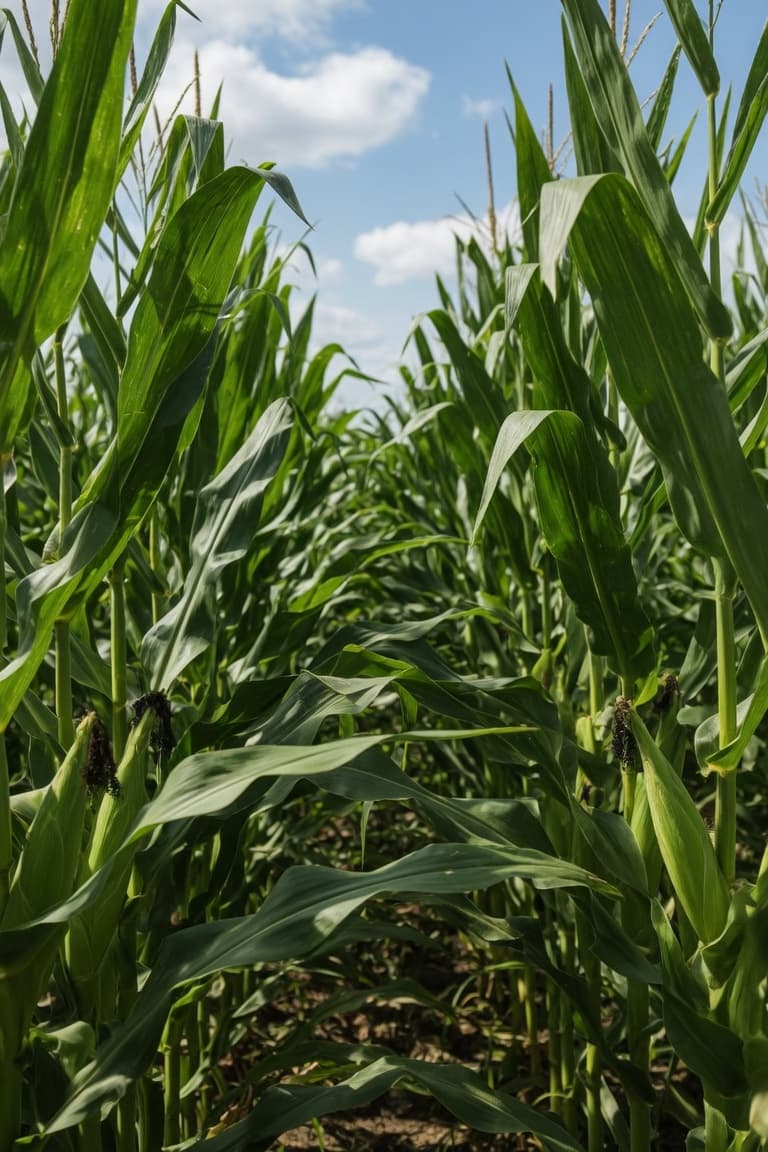
Drive south-central Nebraska this week and the early-planted corn is at V3 to V5 across most of the ground. Sidedress rigs are rolling, pivots are starting to turn, and in the back of a lot of growers' minds is a decision with a ten-day window: should you interseed a cover crop into the standing corn before the canopy starts to close?
The pitch is appealing on paper. Get a clover, brassica, or annual ryegrass mix down between the rows while the corn is still short. Let it establish in the understory through summer. Come out of harvest with a cover crop that's already six to eight weeks ahead of anything you could drill in October. No combine tracks to chase, no daylight to run out of.
Several growers have asked us in the last two weeks whether a drone is the right tool for that pass. The shorter question — should you do this at all on Nebraska corn — deserves an honest answer first. Here it is.
What the Nebraska Research Actually Says
This is where it gets uncomfortable. Most of the cheerful interseeding press comes from Minnesota, Michigan, Pennsylvania, and Ontario — wetter, cooler corn belts with less summer drought stress on the cover crop and less competition with the corn at the critical V8–VT growth window. The Nebraska numbers are more cautious.
UNL's on-farm research program — in a multi-year collaboration with The Nature Conservancy, the Upper Big Blue NRD, and cooperating farmers across Seward, York, Clay, and Hamilton counties — ran early-season interseeding trials from 2019 through 2022. The 2019–2022 summary in CropWatch is the line every Nebraska grower should read before booking this work: across the program, corn yield was reduced in six of twelve site-years where the cover crop was interseeded compared with the no-cover check. The 2020 V4 sites in particular averaged a five-bushel drag — 214 bu/ac on the check versus 209 bu/ac with the interseed, statistically significant at p = 0.001 — and four of those six sites individually showed a meaningful yield hit.
UNL's own takeaway is direct: aim for V4 if you're going to do it, because the canopy closes too quickly when interseeding at V5 or V6 and the cover crop ends up either failing to establish or competing with the corn during the kernel-row determination window. V4 was the least-bad option in their trials, not a clean win.
Compare that with University of Minnesota's results: UMN trials interseeding cereal rye, medium red clover, and annual ryegrass at V2, V5, and V7–V8 in Minnesota corn showed essentially no yield drag and no impact on the following soybean crop. The difference isn't the research method. It's the climate. South-central Nebraska in July is hotter and drier than central Minnesota, and a thin cover-crop stand sharing soil water with a V8 corn plant in 92-degree weather is a much bigger ask of that field than it is at Lamberton.
Practical Farmers of Iowa saw the same split on cooperating farms in 2021: at the Sloan farm, an interseeded mix overwintered and produced biomass equal to fall-drilled covers, and the following year's corn out-returned the winter small-grain treatment by $39/ac. At the Boyer farm, the same year, the interseeded mix didn't overwinter at all. Win-rate isn't 100%, and the Nebraska on-farm work suggests the corn-yield risk is real enough to plan around before the seed order goes in.
If You're Going to Do It, the Window Is Right Now
USDA NASS reported Nebraska corn planting at 92% complete by May 24, 2026 — slightly ahead of the five-year average. The earliest-planted ground is at V4 to V5 this week, and the rest of the early plantings will hit V4 over the next ten days. That's the entire window.
Once corn reaches V6 the canopy is closing fast. Light at the soil surface drops below what a clover or ryegrass needs to establish, and the seed you just paid for sits on dry ground waiting to be eaten by birds or run off with the next inch of rain. Miss the window and you've spent the money for nothing.
That timing pressure is exactly why this is a drone job, where it's a job at all.
Where the Drone Actually Fits
High-clearance ground interseeders exist — purpose-built rigs with seed boxes that drop seed between rows through V5 or so — but they're rare, they're expensive to hire across the state, and they tear up rows you've already paid to plant. Airplanes can broadcast cover-crop seed at this stage, but no airplane operator wants a 30- or 80-acre interseeding job in early June when the rest of their book is corn fungicide pre-orders, and the airplane's swath control isn't tight enough to follow a field edge cleanly with a $0.50/lb seed mix.
The drone fits this window the same way it fits any other tight aerial job. A Talos T60x or DJI Agras-class drone can broadcast seed at a GPS-calibrated rate, hold a swath edge within a few feet, and fly a field that's too wet for a high-clearance rig to enter. Expect 4 to 6 acres per tank load at typical seeding rates — slow compared to a fungicide pass, but acceptable on a job where the alternative is "can't be done."
What the drone does not do is fix the underlying agronomy question. If your field is one of UNL's four-of-six sites where the cover crop costs you five to eight bushels, the drone put that seed down faster and cheaper than any other tool — and the practice still cost you five to eight bushels. The drone is the right tool for the window; the window question and the agronomy question are not the same question.
Species and Herbicide Compatibility
If you've decided to interseed, two choices matter more than which aircraft drops the seed.
First, species. Brassicas, red clover, crimson clover, and hairy vetch tolerate the late-summer shade under a corn canopy reasonably well. Annual ryegrass is the most forgiving grass. Cereal rye broadcast at V4 in Nebraska is a tougher call — rye is the workhorse for post-harvest drilling for a reason, and it competes hard once it establishes. Typical drone broadcast rates run around 25 lb/ac of annual ryegrass or 20–25 lb/ac of crimson clover; for mixes, SARE's published guidance is 8 to 15 lb/ac of crimson with 18 to 25 lb/ac of annual ryegrass.
Second, your residual herbicide program. UNL's 2024 trial work tested whether Verdict (saflufenacil + dimethenamid-P), acetochlor + atrazine, and s-metolachlor + atrazine would knock down interseeded covers at V2, V4, and V6. The headline answer was that all three are workable at V4 — biomass was reduced but the covers established — and PRE + POST programs were statistically equal across treatments at the biomass level. What you should not do is plant the cover into a long-residual program built around isoxaflutole or full-rate mesotrione and expect the seed to come up. Pair this with your retailer before the order goes in, not after.
What This Should Cost on a Real Field
Our cover crop seeding rate runs $15/ac plus seed, with the same $400 trip minimum as every other job we fly. Annual ryegrass in the south-central Nebraska market is around $1.10–$1.30/lb; crimson clover is $2.50–$3.00/lb. So pencil $45–$55/ac all-in for the interseed.
On a 200-acre block, that's $9,000–$11,000 you've put on the field before harvest. If the agronomy works and you save the post-harvest drilling pass, you've come out roughly even on the dollar and ahead on stand quality and timing. If the corn yield drag shows up at five bushels, you've spent that $9,000–$11,000 and given up another $4,000-plus on the corn check. That math is why we'd rather have an honest conversation about whether your specific field is a fit before we book the flight.
The Bottom Line
Early-season cover crop interseeding is a real practice with a tight window, real research backing, and real risk on Nebraska ground specifically. The drone is the right tool to put the seed down if you've decided to do it. The harder decision is whether to do it at all — and the UNL on-farm work argues for a yes at V4 on cooler-than-average ground with a forgiving residual program, and a slower yes on dry, droughty, or full-atrazine fields.
If you want to walk through whether your particular field and program is one we'd recommend interseeding on this June, call (402) 326-5811 or reach us through the cover crop seeding page. We'll tell you straight whether the drone earns its keep on your acres or whether the post-harvest drill remains the better play.