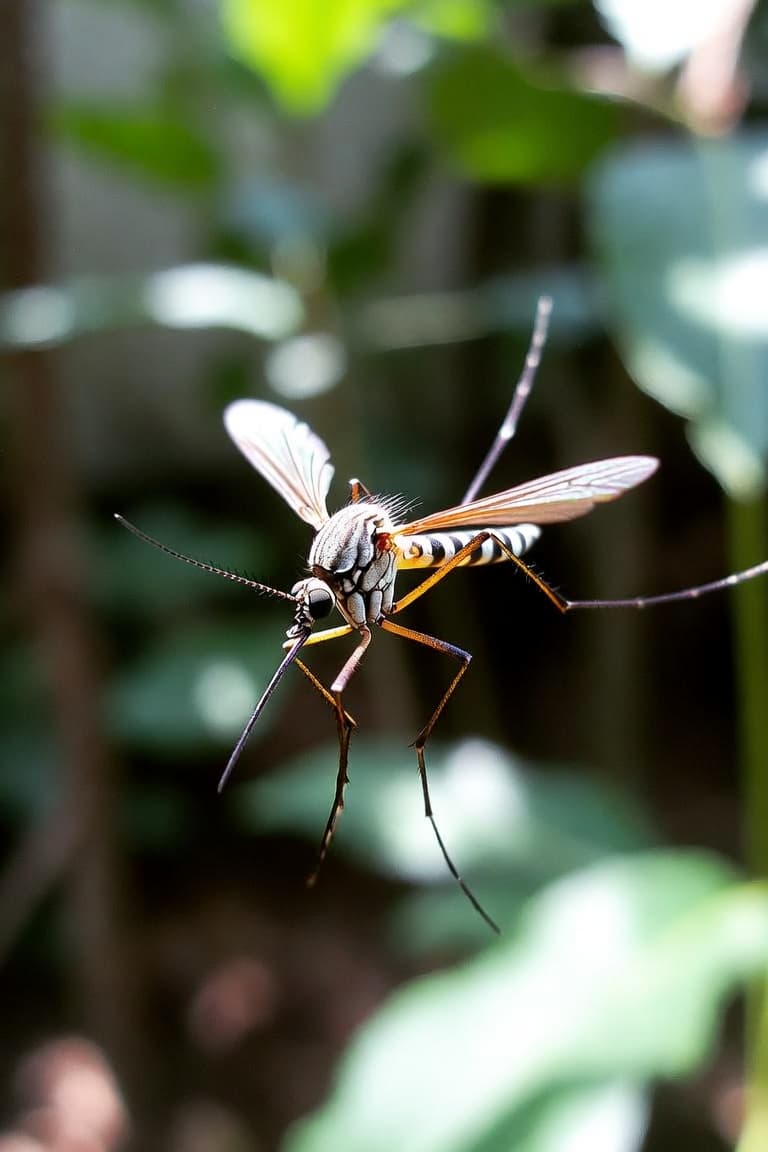
Step out back at dusk in July and the first bite usually lands before you've crossed the patio. Those mosquitoes aren't rising up out of the open grass. They spent the hot part of the day resting in the shade — the treeline at the back of the lot, the dense plantings along the north foundation, the cedar windbreak, the tall weedy fence row. As the sun drops, they move out to feed on whoever's standing in the yard. If you want fewer of them biting, that shaded edge is where the fight is. And it's exactly the spot a guy walking the yard with a backpack sprayer can't fully reach.
This isn't just about comfort, either. The mosquito at the center of it in Nebraska is Culex tarsalis — which Nebraska Extension calls "probably the most capable vector of West Nile virus throughout Nebraska and the western U.S." West Nile turns up here every summer. Nebraska DHHS is plain about the math: most people who get infected never know it, about one in five get sick, and under 1% develop the serious neuroinvasive form — but roughly 1 in 10 of those cases is fatal. It's a low-odds, high-stakes bug, and it's a Nebraska regular. That's the backdrop for taking your yard back, not just an annoyance to wave off.
Where the Mosquitoes Actually Are
Here's the thing most yard-spray pitches get backwards: the open lawn is where you get bitten, not where the mosquitoes live. During the day the adults shelter in cover. Nebraska Extension points control efforts at "temporary shallow water with dense vegetation, trees, and shrubbery where adult mosquitoes rest during the day," and recommends keeping lawns mowed and plantings manicured "to reduce mosquito staging areas."
So fogging the middle of the yard is spraying where they aren't. The work is the perimeter — the treeline, the shrubs, the shaded north side of the house, the fence row. Coat the surfaces where they rest, and you knock them down before they ever come out to bite. That's what a barrier treatment is.
What a Barrier Spray Is — and What the Research Says
A barrier (or harborage) treatment lays a residual insecticide on the foliage where mosquitoes rest, so they pick up a lethal dose when they land. It's a real, measured approach, not a marketing line. In a Journal of Medical Entomology study of two pyrethroid barrier treatments on suburban properties, lambda-cyhalothrin and bifenthrin cut Aedes albopictus bites by 89.5% and 85.1% versus untreated yards. Those are the same active ingredients Nebraska Extension lists for residential mosquito work — bifenthrin, permethrin, lambda-cyhalothrin, and cyfluthrin.
I'll be straight about the catch, because it's the one nobody volunteers: a barrier fades. The same study found the treatments start losing their punch about 4 to 6 weeks out, sooner after a hard rain. Through a Nebraska July and August, that means mosquito control is a schedule, not a one-and-done call. Anybody who tells you a single spray fixes your whole summer is selling, not spraying.
The Culex Catch — and Where the Drone Earns It
Now the part that actually matters here. In that same study, the barrier worked on Aedes but did not reduce Culex — and the authors are clear about why. The spray only reached the low vegetation, roughly 0.3 to 3 meters off the ground (call it 10 feet), and Culex rest higher, up in the tree canopy a backpack sprayer couldn't get to.
Read that against Nebraska. Our main West Nile carrier is Culex tarsalis. The mosquito that matters most around here is the exact one a conventional low barrier spray misses — and it misses it for one reason: reach.
That's the gap a drone is built to close. Flying along the canopy, the propeller downwash drives the spray up into the treeline and the upper foliage that a person on the ground walks right past — the same height where Culex shelters. Let me be honest about how far I'll take that claim: I can show you the published trials saying low barrier sprays miss Culex; I can't hand you a peer-reviewed drone-versus-backpack Culex trial, because that work isn't out there yet. But the mechanism is simple and it's real. You can't kill a mosquito resting eighteen feet up with a spray that quits at ten. A drone reaches it.
The rest of the case is the everyday stuff: GPS-guided passes lay an even barrier across the whole property with no skipped strips, larger and hard-to-reach acreages get treated without a truck or ATV rutting up your lawn, and most yards are done in one quick visit. The full rundown lives on our mosquito control page.
Where a Barrier Spray Loses — and It Does
I'd rather tell you the limits up front.
It is not a substitute for dumping standing water. Nebraska Extension is blunt that "the most important element in mosquito control is the removal of standing water." Birdbaths, clogged gutters, flower-pot saucers, the kiddie pool, rain barrels, old tires, that low spot by the shed that holds a puddle for a week — drain or dump them, and rinse the birdbath weekly. A barrier kills the adults resting in your trees; it does nothing about the larvae growing in the bucket by the garage. The CDC frames mosquito control as layered for exactly this reason — no single method does the whole job. Spray and source-reduce, or you're fighting with one hand.
It fades, on a calendar you don't control. Four to six weeks, faster after heavy rain. Real protection through peak season is a cadence, not a single visit.
A tiny in-town lot may not need a drone. If you've got a small yard with no real treeline, a guy with a backpack can probably do it as well for less — the drone's edge is reach and acreage, and on a postage-stamp lot there isn't much of either to exploit. We'll tell you if that's your situation instead of flying it anyway.
Your neighbor's pond isn't yours to fix. A barrier protects your property. It can't out-treat a breeding source running over the fence from the ditch or the pasture next door.
The label runs the job, drone or not. These are EPA-registered pyrethroids. We apply by the label, keep product off blooming plants where bees are working, and ask that people and pets stay off treated areas until they're dry — usually about 30 minutes. A drone doesn't change any of that. An applicator who won't talk to you about the label and the pollinators is telling you something.
What It Costs, and Getting on the Schedule
There's no per-acre sticker price on this one, and I won't make one up — yards differ too much in size, treeline, and access for a flat number to mean anything. We quote by the property, it's free, and usually same day. Peak mosquito season books up fast.
Call (402) 326-5811 or request a quote with your address, and we'll get you on the schedule. More on how it works is on the mosquito control page.
The Bottom Line
Mosquitoes own the shaded edge of your yard, not the open lawn — and in Nebraska the one that carries West Nile, Culex tarsalis, rests up in the canopy where a ground-level barrier spray runs out of reach. A drone gets product up there, covers the whole property evenly, and does it without equipment on your grass. Pair that with dumping the standing water around the place, and you've got both ends of the problem covered instead of one.
If the bites are driving everyone indoors by 8 p.m., call (402) 326-5811 or reach us through the mosquito control page, and we'll get you a straight read on your property.