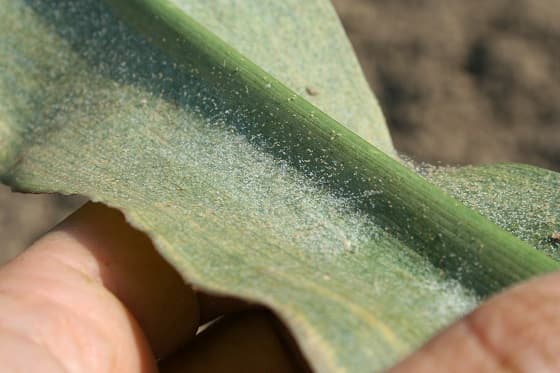
Walk the road edge of a soybean field this week and the leaves along the ditch look off — dull, bronzed, yellowing at the bottom of the canopy. Easy to write off as drought; much of the state's been dry since spring. But pull a leaf and turn it over. If the underside shows fine sandblasted stippling, a little webbing in the leaf axils, and specks barely bigger than dust that move when you breathe on them, that's not drought — it's twospotted spider mites, and the same dry stretch stressing the crop is breeding them.
This pest sneaks up on a dry year. It doesn't fly in on a calendar like the cutworm moths — it builds quietly on the edges while you're watching tassels, and by the time the field looks sick it's already cost you. Here's how to catch it, whether it pays to spray, and where the drone fits — because this is one job the drone doesn't automatically win.
Why Dry Years Are Mite Years
Spider mites run on heat and drought, which speed their reproduction and stress the host plant. UNL Extension puts it plainly: a hot, dry June through August can push mites to damaging numbers across most of Nebraska's corn and bean country, and the drier, sandier central and western counties get hit first.
What growers forget is that a fungus normally keeps mites in check — a spider-mite-specific disease (Neozygites floridana) that crashes colonies, but only in cool, humid weather below the mid-80s. In a hot, droughty stretch it sits dormant and the mites run unchecked. That's the literal reason old-timers say a good rain knocks the mites back: the humid days behind it flip the fungus on again.
The Trap: Your Earlier Spray May Have Made It Worse
Here's the part that stings. Mites are also held down by a crew of predators — predatory mites, the mite-destroyer beetle, six-spotted thrips, minute pirate bugs — and a broad-spectrum insecticide wipes them out. UNL is direct about it: a lot of mite blowups trace back to an earlier pass for western bean cutworm or rootworm beetles that cleared the predators and left the mites unchallenged.
Most pyrethroids make it double trouble. With one exception — bifenthrin — they don't kill mites well but they're murder on the predators, so the population rebounds on a field with nothing left to eat it. If you flew a pyrethroid on Japanese beetles or grasshoppers along a hot, dry edge a couple weeks back, don't be surprised if that's where mites light up now.
Scout It Right — and Don't Confuse It With Drought
Mites start on the margins. Scout the field edges first — especially next to grassy ditches, alfalfa, wheat, and dusty roads — and walk them again every few days. Populations double fast, and a field that's clean Monday can be over the line Friday.
The mistake in a dry year is spraying off the look of the field instead of the bug — drought yellowing and a couple of foliar diseases mimic mite damage from the pickup seat. Flip the lower leaves and check the underside with a hand lens: you want to see the mites, eggs, and webbing before you spend a dime. In beans it's always the twospotted mite; in corn you might also have Banks grass mite, which starts on fields next to wheat or grass and doesn't take quite the same chemistry.
The Spray Call — There's No Clean Number
Mites don't come with a tidy per-plant threshold the way aphids or cutworms do. On soybeans, UNL leans on a 0-to-5 damage rating, and the spray line is a 3: heavy stippling on the lower leaves with damage climbing into the middle canopy, live mites up there too, and lower leaves yellowing and dropping. Below that, you watch. Left to run past it, a mite infestation hitting beans in late vegetative through early pod can pull 40 to 60% off the yield — not a minor pest once it gets going.
On corn the damage matters most when it climbs to ear-leaf level and above during grain fill, and there's a hard stop: past dent, a miticide won't pay. Colorado State's gut check — treat when damage shows in the lower third of the plant and live colonies have reached the middle third.
The Products That Actually Work
The workhorses are dimethoate and bifenthrin, often paired because they hit different stages. Bifenthrin is the one pyrethroid that earns its place on mites — it's why combinations like Hero exist. The true miticides — Zeal (etoxazole), Comite (propargite), Oberon (spiromesifen) — carry corn labels and are strong on eggs and immatures. One local quirk: Onager is corn-labeled only west of Highway 281 in Nebraska, which leaves out a lot of our home ground east of Hastings. Chlorpyrifos — old Lorsban — still carries a soybean mite label, but it's been through years of legal back-and-forth at EPA, so check it's still cleared before you build a plan around it.
Whatever you pick, plan on the mites coming back: the eggs shrug off most of these products, so a reinfestation 7 to 10 days later is normal, and a bad field often takes a second pass.
Where the Drone Is Honestly Challenged
I'll be straight, because this pest punishes a thin pass worse than any other. Mites live on the leaf undersides, and the only thing that kills them is spray physically reaching them. UNL wants three or more gallons of water per acre by air, put on early morning or late evening so hot midday air doesn't carry it off the plant. A drone can do it, but only with the carrier volume cranked up and the speed down — a fast, low-water, midday mite pass is worse than not spraying, because it flares what it doesn't kill.
And the honest verdict a salesman won't give you: in a dry year your beans are short, and a ground rig can drive them at 20 gallons an acre — the gold standard for coverage. On a full-field soybean blowup, the ground rig usually wins, and I'll tell you that.
Where the Drone Still Earns It
Flying it on makes sense where a ground rig and an airplane don't fit. Tall corn in July is the obvious one — you can't drive a sprayer through it, so it's air or nothing, and a drone with enough water at first light competes fine with the plane. The other is the edge job: when the mites are stacked in a 200-foot band off the road and the interior is still clean, a drone treats that exact ribbon instead of the whole section.
The one rule that doesn't bend: enough water, right time of day. If anyone offers to fly your mites, ask what carrier rate they're running. A low number says they're treating it like a herbicide pass — and mites don't forgive that.
The Bottom Line
Mites are a dry-year, edge-first problem that turns whole-field if you miss the start. Scout the margins now, confirm it's actually mites before you spray, and hold the line until the damage climbs the canopy. When it's time, the answer might be a drone, a ground rig, or a rain — and a straight operator helps you tell which.
Want a second read before you spend the money? Call me at (402) 326-5811 or reach out through the spraying page. I'll fly what flies well, send you to the ground rig on the rest, and either way give you a straight answer on whether the mites are worth chasing yet.