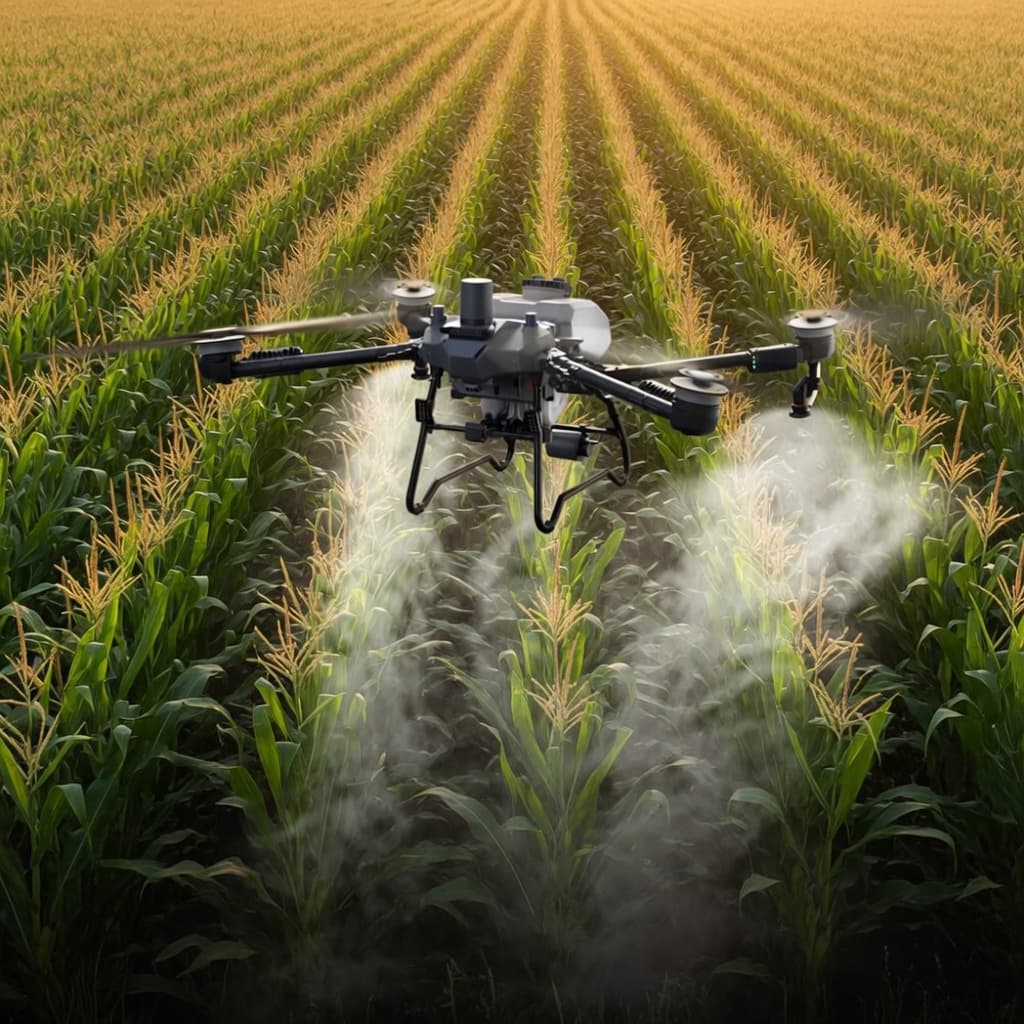
The tassel-stage fungicide window on Nebraska corn is tight — roughly VT through R2, call it a 7–12 day stretch depending on hybrid and weather. Miss it and the ROI drops fast: agronomists and fungicide-trial programs consistently show VT/R1 as the highest-return timing for foliar fungicide on corn, with meaningful yield-response drop-off on either side of that window.
And once the corn hits 8 feet tall, you're not driving through it. So for most Nebraska growers, this isn't a "drone vs. ground rig" conversation — it's a drone vs. airplane decision. Here's what actually separates them.
The Rate Card
The per-acre application cost for a VT/R1 fungicide pass, in rough 2026 Nebraska numbers:
- Airplane aerial application: $12–$18/ac. 40–80 acre minimum.
- Drone application: $13–$15/ac. No hard minimum; $400 trip floor.
If you have 400+ acres of contiguous, rectangular corn, airplane wins on sticker. That's the real answer and nobody benefits from dressing it up.
But sticker price is one line of the comparison. Here are the four others that matter.
Timing, Boundaries, and Drift
Both airplanes and drones need calm-enough conditions for a quality application — call it under 15 mph sustained wind for either platform if you care about drift and coverage. Beyond that, spray quality degrades quickly regardless of the aircraft. So the drone doesn't win on wind tolerance. It wins on three other weather-and-boundary factors.
Scheduling. In an active Nebraska summer, when every corn grower in a 200-mile radius is trying to hit the same VT/R1 window in the same week, airplane schedules get crushed. A single local drone can often get your field on the book when the airplane is committed three days out.
Drift control near sensitive boundaries. A drone flies 6–10 feet above the canopy at 10-30 mph. An airplane flies 10–15 feet above at 130+ mph. The combination of lower altitude, slower speed, and prop downwash produces less off-target drift — which matters when your corn borders a specialty crop, an organic field, a pasture with sensitive livestock, a homestead, or a CRP strip.
Boundary precision. Drone GPS geo-fencing holds a field boundary within a few feet. Airplane swath control is wider. If your field has inset specialty crops, neighbors' sensitive plantings, or tight geometry, the drone gives you cleaner coverage without over-spray.
The practical result: the drone often gets your fungicide on in the VT/R1 window when the airplane can't. That's where the dollar-per-acre conversation flips — missing the window costs more than the $4–5/ac price gap.
Canopy Penetration and Yield Response
This one is counterintuitive. Common sense says "the airplane has more air moving — it must push product into the canopy better."
What multiple independent trials actually show is a tighter comparison than that. A drone flying 10 feet above tassels at 20 mph generates concentrated propeller downwash that pushes droplets down through the canopy. University of Kentucky on-farm trials comparing a DJI T-10 drone against a ground sprayer at VT/R1 on corn, using Delaro Complete at label rate, found similar levels of disease control and yield response from both application methods.
Purdue University trials on corn and soybeans have reported the drone sprayer generated more consistent coverage from top to bottom of the canopy than a ground machine did — with a much smaller droplet size. In Purdue's plots, a DJI T10 applying fungicide at 5 gallons per acre produced the lowest level of tar spot of any treatment in the trial.
The most striking yield comparison comes from Beck's Hybrids' on-farm corn fungicide PFR study: corn with a ground-rig fungicide application at 15–20 GPA yielded 235 bu/ac; corn with a drone application at just 2 GPA yielded 237 bu/ac. Essentially identical yield at one-eighth the carrier water volume — and Beck's reported the drone's ROI at $13.17/ac vs. $8.44/ac for the ground rig.
None of that means drones are magic. It means the coverage-quality gap against ground and aerial application has closed faster than most producers expected.
Field Geometry and Minimums
This is where drones clean up.
Airplane strength: large, flat, rectangular fields where the airplane can run long passes and minimize turn time. A 160-acre quarter is the airplane's happy place.
Airplane weakness: fields with high-tension power lines, CRP strips, trees, terraces that fall off sharply, adjacent specialty crop or organic production, or any shape requiring tight turns. Airplanes also typically require a 40- to 80-acre minimum — which excludes a huge slice of Nebraska seed corn, sweet corn, and specialty production.
Drone strength: irregular, small, or otherwise pinched fields; seed-corn blocks; fields next to sensitive boundaries; pivot corners; partial-field touchups.
A common real-world job: a grower has 320 acres in a quarter under center pivot and wants VT/R1 fungicide on all of it, plus 12 acres of seed corn in a separate block 3 miles away. The airplane does the pivot acres profitably but declines the seed corn block. The drone does the seed corn block plus any trouble areas on the main pivot (pivot corners that the airplane's GPS boundary isn't tight enough for) — often in the same day.
Insurance and Paperwork
One last factor most rate sheets ignore: compliance and traceability.
Every drone pass produces a coverage report — a GPS trace of the flight path, per-acre application rate, product mix, wind and weather conditions at the time of spray, and a timestamped field boundary. If your seed-corn contract, organic-buffer requirement, or Climate FieldView integration asks for that data, it's already in the report.
Airplane applications typically don't generate that level of documentation. Most airplane operators provide a flight log and a per-acre invoice, but not a GPS coverage map. For growers with data-traceability requirements (seed corn contracts, organic certification, some specialty buyers), the drone's record-keeping is a real differentiator.
The Quick Decision Tree
For a typical Nebraska corn grower in July:
- 400+ acres contiguous, rectangular, accessible, no sensitive boundaries: Call the airplane first.
- Under 100 acres, or a block the airplane has declined before: Drone.
- Seed corn, organic, specialty, or high-traceability contracts: Drone.
- Pivot corners, pinched fields, or trouble areas: Drone — often as a supplement to an airplane doing the main job.
- The window is closing and the airplane is booked through next Tuesday: Drone.
Our Approach on Fungicide
At Nelson Drone, we fly VT/R1 fungicide on Nebraska corn with a2 gal/ac carrier volume, which is the sweet spot for canopy penetration without over-applying. Our agricultural spraying rate card puts fungicide at the $13–15/ac range, and we can hit 200–400 acres a day with a single T60x.
For large rectangular jobs we'll honestly recommend the airplane first. For everything else — seed corn, pivot corners, sensitive boundaries, short-notice jobs that missed the airplane's schedule, or anything under 80 acres — that's exactly what we're built for.
Call (402) 326-5811 or reach us through the site to get on the schedule before the VT window opens.