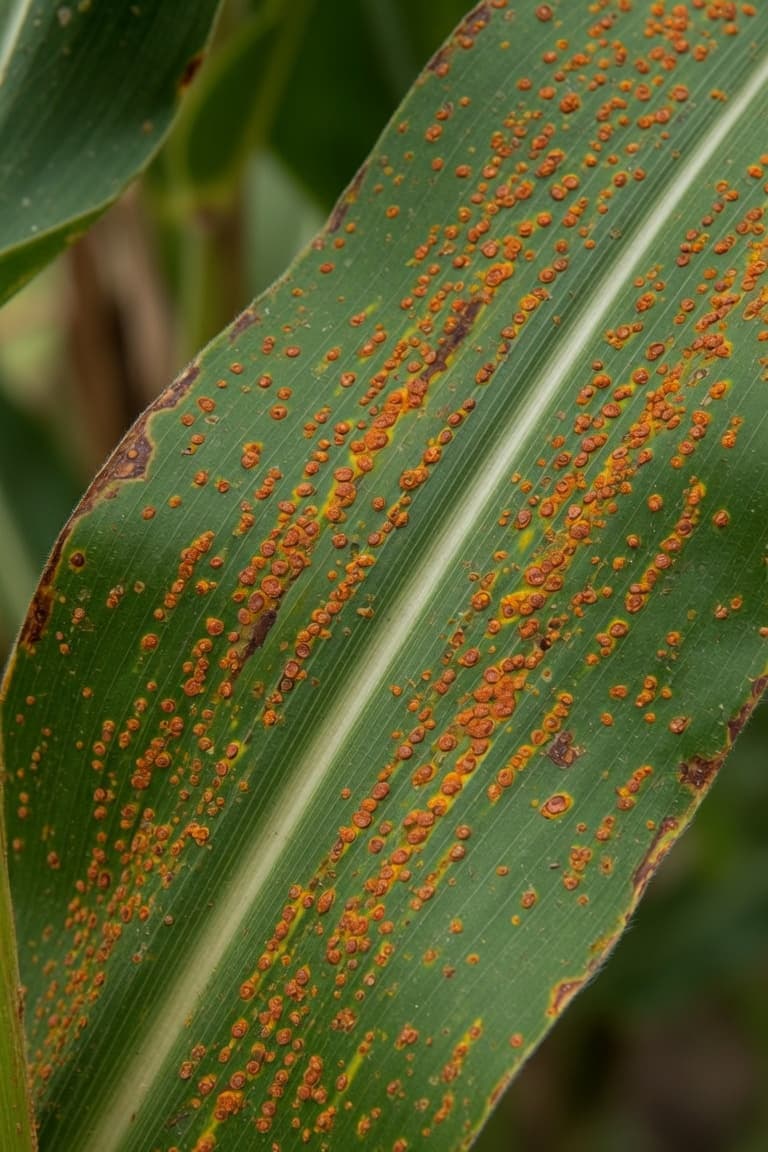
Every year you put thousands of dollars into seed, fertilizer, herbicide, equipment, and labor. When disease pressure starts to build, a well-timed fungicide pass can be one of the most profitable inputs you make all season. The catch is in the word timed. Product choice gets most of the attention, but on corn and soybeans the window you spray in moves the yield needle more than which jug you pull off the shelf.
This is the companion piece to our drone-vs-airplane breakdown on tassel fungicide. That post answers which aircraft. This one answers the question that comes first: when.
The Window Is the Whole Game
Spray too early and the crop sits unprotected through the stretch when disease actually does its damage. Spray too late and you're paying to slow down a yield loss that's already on the books. The goal is narrow: protect the plant during the stages when it's most vulnerable and when keeping leaves healthy has the biggest payoff for fill.
On corn, that window is VT to R1 — tasseling through silking. This is when the plant is pouring everything into grain fill, and keeping the upper canopy clean keeps photosynthesis running through the part of the season that sets your yield. This isn't just agronomist folklore. A Corn Disease Working Group study across 15 states found the most consistent yield response came from applications made between VT and R1, and a national meta-analysis since has confirmed VT/R1 as the highest-return single-pass timing. In that work, tasseling applications consistently beat early-vegetative (V6) ones — averaging roughly 3.3 bu/ac for strobilurin-only products and 7.2 bu/ac for the premium DMI + strobilurin mixes.
On soybeans, the equivalent window is R3 — beginning pod. University of Missouri research pulling together 33 tests from 2018–2020 put the average R3 response at about 1.5 bu/ac, with a 90% chance the true mean landed between 1.2 and 2.2 bu/ac. More recent 2024 trials spanning Nebraska, Iowa, Kansas, Illinois, and Wisconsin came in higher — around 2.5 bu/ac on average, with some sites hitting nearly 4. R3 also showed cleaner pods, with less frogeye leaf spot and Septoria than untreated checks.
One honest caveat the same research keeps repeating: the response shows up when disease pressure is there. In a dry, low-pressure year with no moderate-to-severe disease, a fungicide pass often won't clear its own cost. Timing matters most precisely because it's a preventative play — which brings up the trap that catches a lot of growers.
Waiting Until You Can See It Is Already Too Late
Most of the foliar diseases that matter — gray leaf spot and tar spot on corn, frogeye and Septoria on beans — spread fast once the weather turns warm and humid. By the time you can see lesions from the pickup, the infection has been working for a while and yield loss is already accruing. Fungicides are far better at protecting clean tissue than at rescuing infected tissue.
That's why the preventative pass at the correct growth stage so reliably out-earns the "wait and see, then react" approach. You're not spraying because the field looks sick. You're spraying because the calendar and the forecast say the field is about to be at risk. The decision has to be made looking forward, not in the rearview mirror.
Timing Is Where the Drone Earns Its Keep
Here's the practical problem with a calendar-driven application: the calendar doesn't care whether the field is dry enough to drive. A wet stretch in mid-July can pin a ground rig out of corn for a week — and a week is most of your VT/R1 window gone.
A drone sidesteps that. It flies 8–10 feet over the canopy, so there are no tire tracks, no green snap, no end rows torn up, and no waiting for the ground to firm up. Saturated conditions that keep a sprayer parked usually don't stop a drone. The result is simple but it's the entire point: you apply at the right growth stage instead of waiting for the field to cooperate. When the window is only 7 to 12 days wide, that flexibility is often the difference between hitting it and missing it.
It also helps when everyone's racing the same window. In a busy Nebraska July, when every grower for a hundred miles wants the same VT/R1 week, a local drone can frequently slot your field in when the airplane is booked three days out. We get into the platform-by-platform tradeoffs — drift, canopy penetration, field geometry, and where the airplane genuinely wins — in the drone-vs-airplane post.
What It Costs
At Nelson Drone Solutions, fungicide applications run $13 per acre on fields over 40 acres. Set that against what a foliar disease can take off the top in a high-pressure year — easily several bushels an acre on corn — and a timely pass pencils out as one of the better returns on the farm. The math only works, though, if the product goes on inside the window. A perfect tank mix applied two weeks late is just an expensive way to watch the disease win.
Don't Wait Until It's Too Late
Disease pressure builds quickly once it turns warm and humid, and Nebraska summers deliver plenty of both. If your corn is coming up on tassel or your beans are heading toward beginning pod, now is the time to make the plan — not the week you finally spot lesions from the road.
Call us at (402) 326-5811 or reach out through the site to get your acres on the schedule. The right application at the right time protects yield, keeps the canopy healthy, and does the most for your bottom line — and getting on the calendar early is how you make sure the weather doesn't make the timing decision for you.